The Water Research Building
Red Hook Brooklyn, New York, NY
The Water Research Building is an adaptive reuse proposal situated within a designated portion of the Red Hook Grain Terminal in Brooklyn, NY. The assigned area consisted of nine vertical concrete silos: massive cylindrical volumes with no existing floor plates or horizontal circulation. Rather than drastically altering the historic industrial form, I approached the project with a non-invasive mindset, choosing to remove only what was essential and carefully insert new architectural elements. Floor plates and circulation paths were introduced to create functional spaces within the silos, enabling the transformation into a water-focused research facility. The design aims to preserve the monumentality of the structure while adapting it for contemporary use, fostering both environmental inquiry and architectural continuity.
Site Strategy

2025

2100

2050

2150
The site is located along the Gowanus Canal in Red Hook, where the abandoned Grain Terminal stands. This land was originally man-made in the 1920s to expand the usable waterfront area. However, being directly adjacent to the canal, it faces an inevitable threat: rising tides that will gradually consume the site in the coming decades.
In response, our project proposes a phased strategy to both protect and transform the area over time. Beginning in 2025, the existing concrete platform surrounding the terminal would be converted into a public park for local residents, while new marshes would be introduced to help absorb excess water. By 2050, additional marshlands would be layered directly on top of the remaining concrete surface, continuing the process of softening the site’s edges and enhancing its ecological resilience. This gradual approach would repeat every 50 years, with new interventions added up until 2150, creating a long-term, adaptive landscape that evolves in rhythm with the changing tides.


Interior render of one of the labs
The Water Research Building in Red Hook is conceived as both a protective and investigative space, addressing the urgent challenges posed by rising tides along the Gowanus Canal. Its purpose is to serve as a hub for scientists, students, and community members to study water systems, test new strategies for flood resilience, and foster public awareness about climate change. Inside, the building is designed to feel open and adaptable, with flexible laboratory spaces, research stations, and communal work areas arranged around light-filled corridors. Exposed structural elements and natural materials highlight the building’s connection to its environment, while large windows frame views of the canal, reminding occupants of the water they are working to understand. Public galleries and meeting rooms are integrated to encourage collaboration, making the building not just a research facility, but also a civic space for dialogue and innovation.
Facade


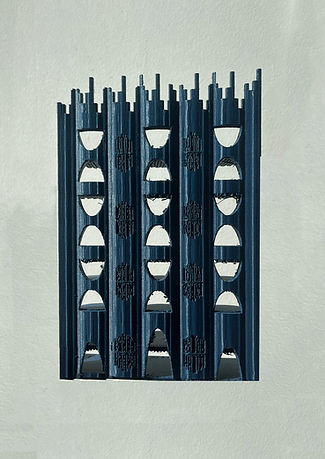

For the Physical model, I 3D printed a section model. This way, the facade shape is succesfully expressed as well as the light that comes in through the windows into the silos.
Since the existing structure was meant to be a facility to hold grain, there is no insulation on the pure concrete silos. Therefore I had to create a facade that included insulation as well as windows that cut through the harsh concrete. In order to continue the idea of Adaptive Reuse I decided to repurpose containers ,that were found in the area, to create panels for the facade.
